
Browse Items (802 total)
- Collection: Collecting the world
Sort by:
snow.knife

Curved blade (tusk ivory) with two parallel incised lines along outer curve on each side, pointed butt fits into V on handle, made in wood with hook at end. Handle sewn to blade by thongs in twisted sinew at three points, through perforations in…
spade
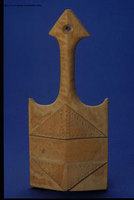
Wooden spade-shaped implement, used for beating clothes when washing. Kosovo work.
spatula lime.spatula

One of two spatulae made from the limb bones of cassowary. Decoration: dots & interlocking step pattern in relief, ornamented with seeds, shells, crab claws, teeth and red cloth.
spatula lime.spatula
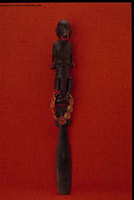
Carved wooden lime spatula, decorated with female figure with glass beads (red), and shell beads (red). Hunt(1981): 'Betel chewing is practised widely in Melanesia. The betal mixture consists of nut of the areca palm, fruit or leaves of the betel…
spear

Steel blade, guard in the form of two gilded animals, long wooden shaft painted in red, black and yellow. Thomson's MS Catalogue: 'Spear - Gold mounted - from Sumatra - bought from Major Ondaatje.'
spear blow.pipe

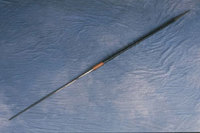
Blow-pipe and spear combined. Steel spear-head and brass fore-sight are attached to the shaft with cane lashings, metal plate as rear-sight is missing. Blow-pipe forms the shaft. Illustrated in Ogston (1884-1929) Volume 3.
spear club

A large wooden spear or club.
spear.head (2) arrow.head

Glass-fronted wooden box containing 2 iron spear-heads and one iron arrow-head, all tanged. Museum labels on front and back of box. Several labels - front of box, top: 244, on back of box, hand-written label in ink: Two spear and One Arrow Head found…
spear.thrower (clewang)

Wooden spear-thrower, from Sumatra? Slip catalogue describes this as a 'chewang', Thomson describes it as a 'clewang'. One of three collected by Thomson and noted in the Accessions Book 1941-1963 as having been donated in 1952, but only one located…