
Browse Items (3473 total)
Sort by:
Letter from J. Ramsay MacDonald to James Leatham
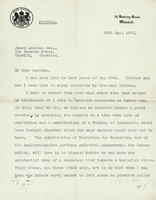
In this letter, J. Ramsay MacDonald tries to reassure James Leatham that in spite of what he [Leatham] might think, MacDonald and his colleagues do consider themselves to be members of the Labour party.
'Back on to our Socialism', An Open Letter to the Right Hon. J. Ramsay MacDonald; letter in reply from J. Ramsay MacDonald to James Leatham

In this open letter to his friend, Ramsay MacDonald, which he published in Gateway, Leatham points out that the government has not delivered the socialist promises made in 1918. As Leatham states at the end of the letter, ‘What we want is to stop the…
Letter from J. Ramsay MacDonald to James Leatham

Letter from Prime Minister Ramsay MacDonald to James Leatham. Leatham and MacDonald had a long correspondence, mainly about political matters. Ramsay writes to thank Leatham for his support of the National Insurance Bill in a leader he wrote for the…
Letter from C M Grieve to James Leatham

This letter to Leatham is from Christopher Murray Grieve, better known as the writer Hugh McDermaid, who at this time was a Scottish Nationalist. The letter reads:
Postponed sending p.o. [postal order] with intention of visiting you - but alas!…
Postponed sending p.o. [postal order] with intention of visiting you - but alas!…
The Ancient Hind

This pamphlet is one of James Leathams's early publications. In 1891 he was a committed Socialist, who spent any spare hours campaigning for social change. This monologue is written in the Aberdeenshire dialect in an attempt to win over potential…
The Only Way with the Land being the Socialist Way

In this pamphlet, Leatham argues that land should not be owned by individuals - wealthy capitalists. Instead, it should be under collective ownership and used for the good of all.
The Gateway Strathspey

James Scott Skinner (1843 - 1927) and James Leatham (1865 - 1945) were friendly and collaborated on more than one occasion. Skinner composed this dance tune as an advertisement for LEatham's periodical, The Gateway. He published The Gateway from 1912…
Should Women Have the Parliamentary Vote?

In this article, James Leatham considers why women should not have the vote. Socialists were not in agreement with women's suffrage.
The Tory Account of the Aberdeenshire Voters

This song appeared in the Aberdeen Herald in October 1832, prior to the first general election after the First Reform Act. The song is an attack on the Aberdeenshire Tories and their candidate, Sir Michael Bruce.
To the Banffshire Voters

This song appeared in the Aberdeen Herald in October 1832, prior to the first general election after the First Reform Act. Colonel Gordon was elected.